
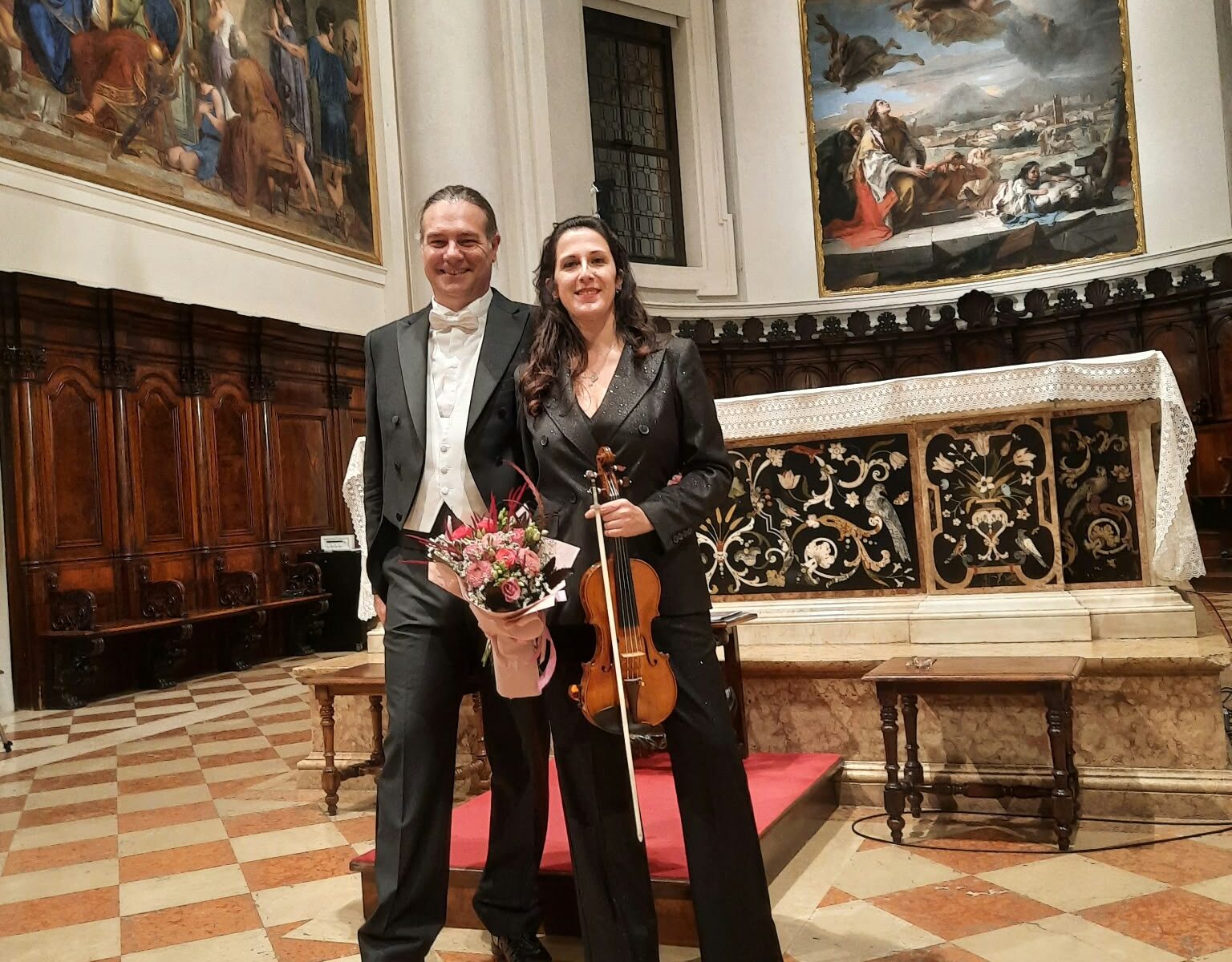
Prima edizione della partitura ritrovata: Bach-Respighi, Preludio al Corale “Nun komm’, der Heiden Heiland” BWV 659 e prima registrazione

Elia Andrea Corazza, Conductor. Emy Bernecoli, Solo Violin. From the concert with the premiere of Bach-Respighi-Corazza, Chorale Prelude "Nun komm', der Heiden Heiland" BWV 659, with the Orchestra Sinfonica del Veneto, Este, Italy, 24 October 2026.


Questa รจ la prima edizione ed edizione critica della trascrizione realizzata da Ottorino Respighi del preludio al corale โ€œNun kommโ€™, der Heiden Heilandโ€ BWV 659 di Johann Sebastian Bach. La versione di Respighi รจ per violino solista, violoncelli e contrabbassi. Lโ€™edizione si basa sullโ€™unico autografo recentemente rinvenuto della partitura.

https://www.universaledition.com/Werke/Nun-komm-der-Heiden-Heiland-BWV-659/P0372663
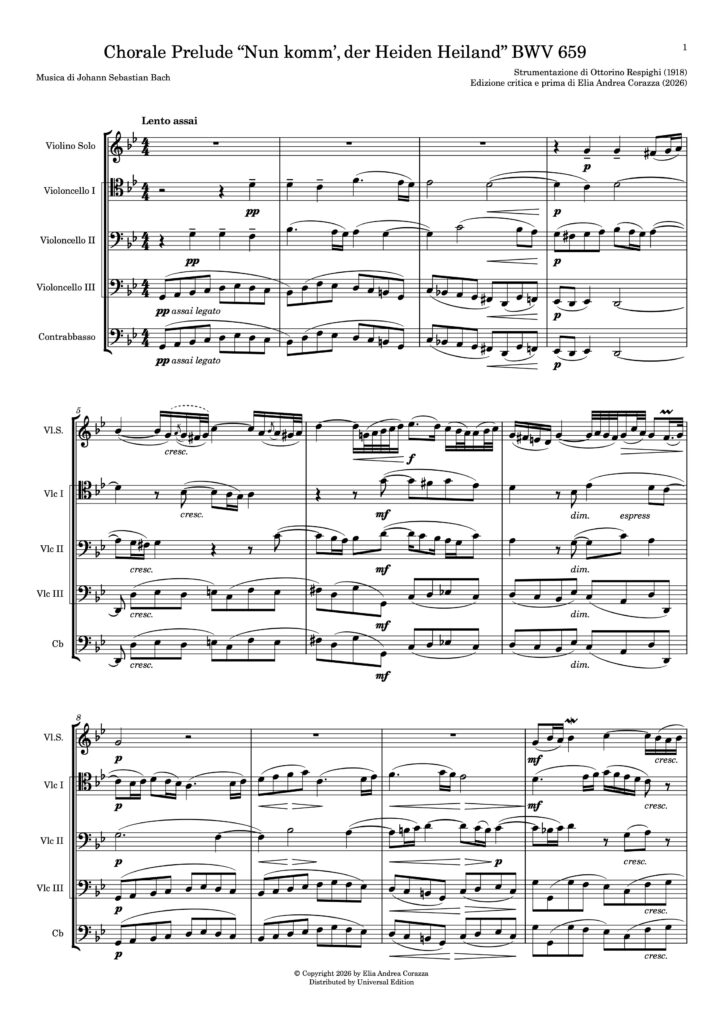
Bach-Respighi, Chorale Prelude "Nun komm', der Heiden Heiland" BWV 659, first edition and first critical edition by Elia Andrea Corazza. Published by Universal Edition Wien.
Bach-Respighi, Chorale Prelude “Nun komm’, der Heiden Heiland” BWV 659, first edition and first critical edition by Elia Andrea Corazza. Published by Universal Edition Wien.

Lโ€™autografo รจ datato Agosto 1918, nellโ€™ultima pagina. Purtroppo non fu rinvenuto dal catalogatore Potito Pedarra ed รจ pertanto assente dal suo catalogo ufficiale. Il brano fu realizzato espressamente per il repertorio concertistico di Arrigo Serato, il piรน importante violinista italiano del primo Novecento.

Arrigo Serato era amico di Respighi fin dai tempi degli studi al Liceo musicale di Bologna. Fu grazie al violinista che Respighi trascorse un periodo di lavoro come pianista accompagnatore per la classe della cantante Etelka Gester, a Berlino, tra il 1908 e il 1909. Il periodo fu proficuo in quanto nella capitale tedesca Respighi, grazie alle introduzioni di Serato, conobbe Max Bruch, Ferruccio Busoni ed ebbe la prima esecuzione di successo con la trascrizione del Lamento di Arianna di Monteverdi eseguita dai Berliner Philharmoniker diretti da Arthur Nikisch. Serato fu costretto a rientrare a Roma allo scoppio della Prima guerra mondiale, e qui riprese i contatti e le frequentazioni con Ottorino Respighi, anchโ€™egli a Roma dal 1913 per insegnare al Liceo musicale di Santa Cecilia. รˆ dunque possibile che Respighi realizzรฒ questa trascrizione anche a seguito dellโ€™omonima trascrizione per pianoforte solo realizzata da Ferruccio Busoni, edita nel 1898 e revisionata proprio nel 1907.

La versione di Respighi, realizzata per violino solista, violoncelli divisi a tre, e contrabbassi, mantiene la tonalitร  dโ€™impianto di Sol minore. Rappresenta un antecedente importante e finora sconosciuto, del noto e celebre primo dei Tre corali, composti nel 1930, dove tuttavia la composizione fu trasposta da Sol minore a Do minore, una quinta sotto, per accentuarne il colore scuro, in cui il violino solo รจ sostituito da tutti i violini, primi e secondi assieme, allโ€™unissono, e la zona scura degli archi รจ raddoppiata dai fagotti.

Qui trovate la partitura e le parti d’orchestra:

https://www.universaledition.com/Werke/Nun-komm-der-Heiden-Heiland-BWV-659/P0372663


Elia Andrea Corazza ne ha realizzato una versione per Violono solo e Orchestra d’archi:
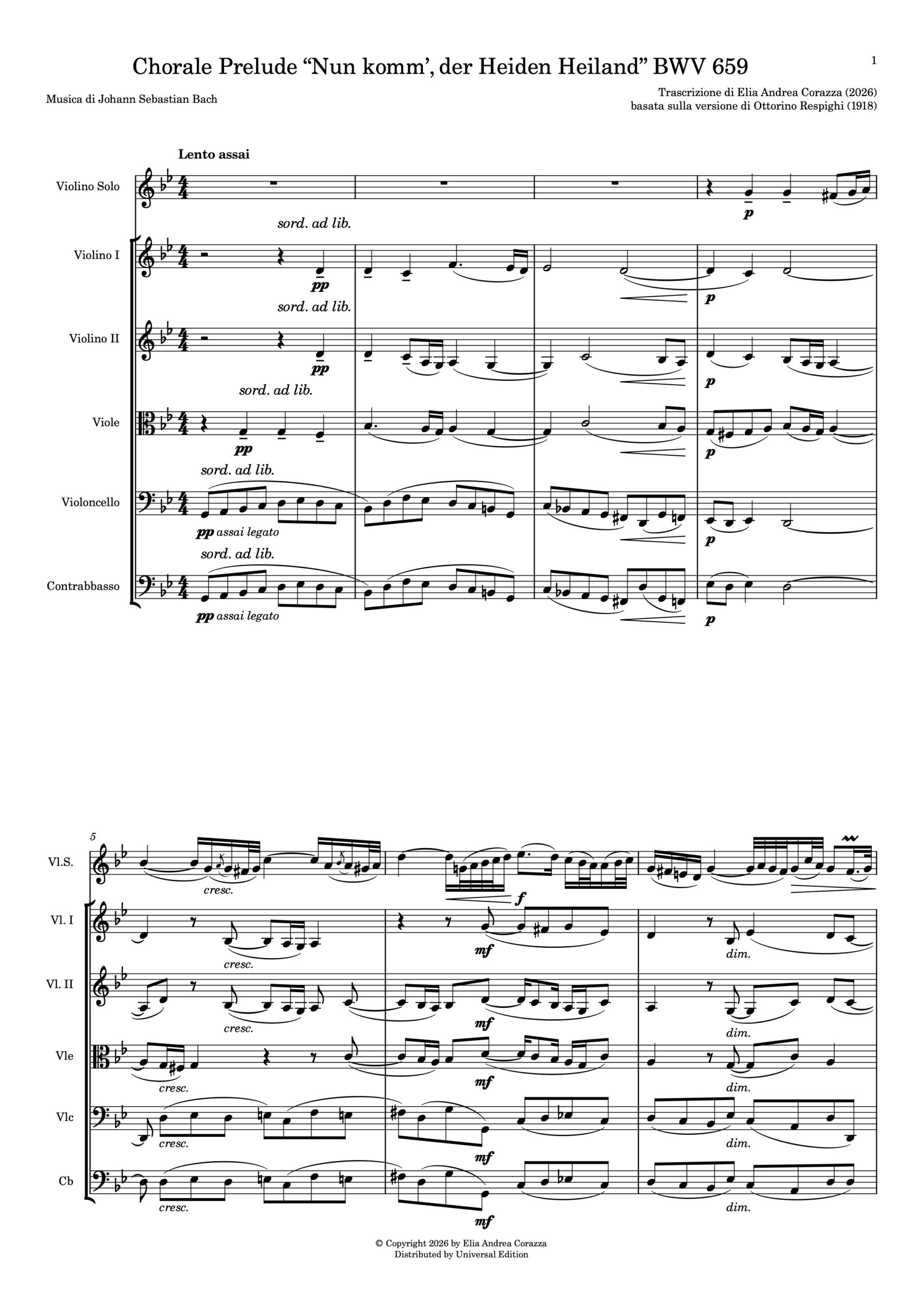
Bach-Respighi-Corazza, Chorale Prelude "Nun komm', der Heiden Heiland" BWV 659. Transcription for Solo violin and String orchestra by Elia Andrea Corazza, based on Respighi original orchestration for solo violin, cellos and double basses (1918). Published by Universal Edition Wien.
Bach-Respighi-Corazza, Chorale Prelude “Nun komm’, der Heiden Heiland” BWV 659. Transcription for Solo violin and String orchestra by Elia Andrea Corazza, based on Respighi original orchestration for solo violin, cellos and double basses (1918). Published by Universal Edition Wien.

La partitura e le parti sono disponibili qui:

https://www.universaledition.com/Werke/Nun-komm-der-Heiden-Heiland-BWV-659/P0372679

Prima esecuzione:
24 ottobre 2026, Cattedrale di Santa Tecla, Este, Italia.
Orchestra Sinfonica del Veneto.
Emy Bernecoli, violino solista.
Elia Andrea Corazza, direttore d’rochestra.


Riduzione per Violino solo e pianoforte:
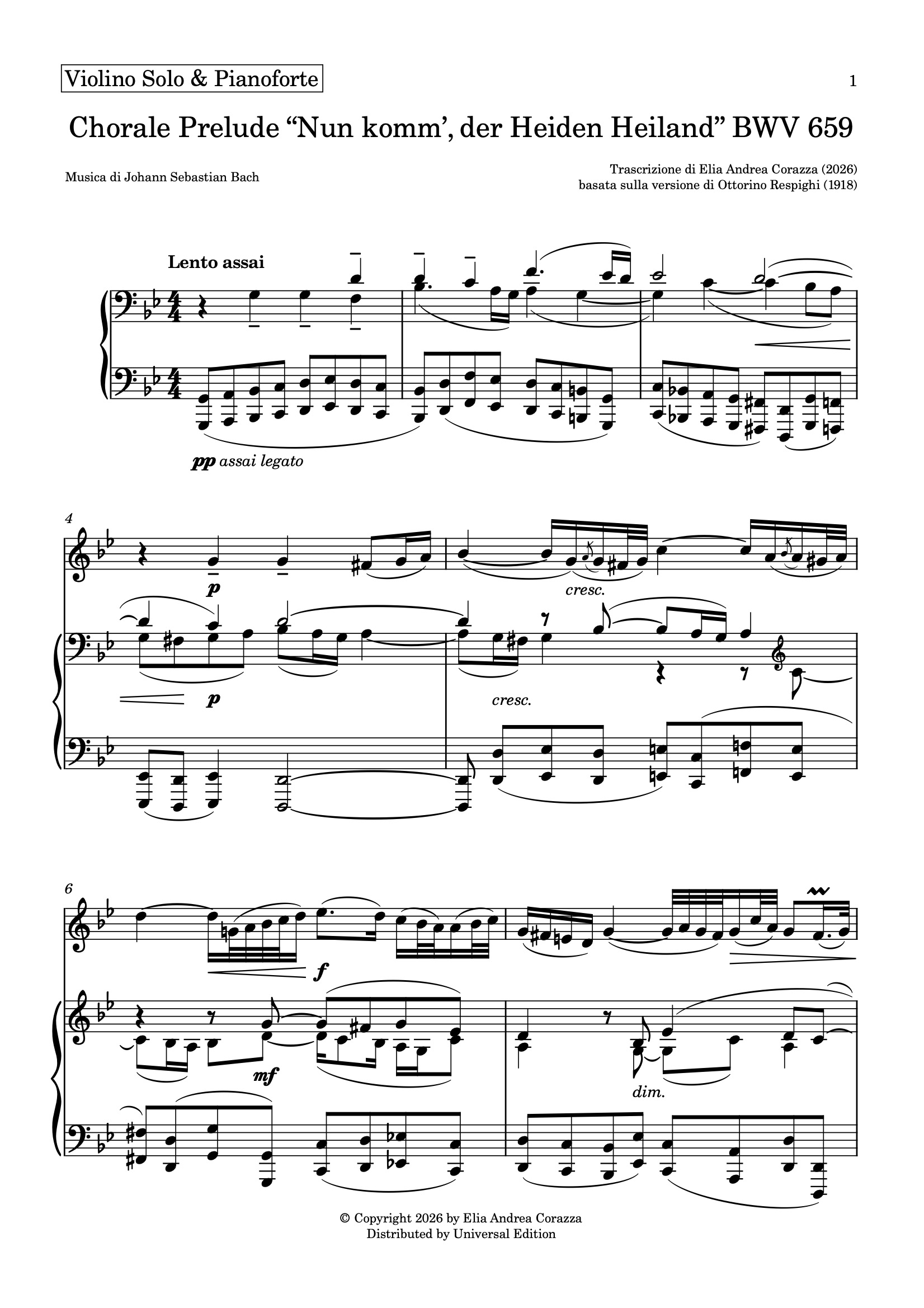
Bach-Respighi-Corazza, Chorale Prelude "Nun komm', der Heiden Heiland" BWV 659. Reduction for solo violin and piano by Elia Andrea Corazza, based on Respighi original orchestration for solo violin, cellos and double basses (1918). Published by Universal Edition Wien.
Bach-Respighi-Corazza, Chorale Prelude “Nun komm’, der Heiden Heiland” BWV 659. Reduction for solo violin and piano by Elia Andrea Corazza, based on Respighi original orchestration for solo violin, cellos and double basses (1918). Published by Universal Edition Wien.

download your copy here:

https://www.universaledition.com/Werke/Nun-komm-der-Heiden-Heiland-BWV-659/P0372650

First edition of the discovered score: Bach-Respighi, Chorale Prelude “Nun komm’, der Heiden Heiland” BWV 659, and first recording

Elia Andrea Corazza, Conductor. Emy Bernecoli, Solo Violin. From the concert with the premiere of Bach-Respighi-Corazza, Chorale Prelude "Nun komm', der Heiden Heiland" BWV 659, with the Orchestra Sinfonica del Veneto, Este, Italy, 24 October 2026.


This is the first edition and critical edition of Ottorino Respighiโ€™s transcription of Johann Sebastian Bachโ€™s chorale prelude โ€œNun kommโ€™, der Heiden Heiland,โ€ BWV 659. Respighiโ€™s version is scored for solo violin, violoncellos, and double basses. The edition is based on the only recently rediscovered autograph manuscript of the score.

https://www.universaledition.com/Werke/Nun-komm-der-Heiden-Heiland-BWV-659/P0372663

Bach-Respighi, Chorale Prelude "Nun komm', der Heiden Heiland" BWV 659, first edition and first critical edition by Elia Andrea Corazza. Published by Universal Edition Wien.
Bach-Respighi, Chorale Prelude “Nun komm’, der Heiden Heiland” BWV 659, first edition and first critical edition by Elia Andrea Corazza. Published by Universal Edition Wien.

The piece was written expressly for the concert repertoire of Arrigo Serato, the most important Italian violinist of the early twentieth century. Arrigo Serato had been a friend of Respighiโ€™s since their student days at the Liceo musicale in Bologna. It was thanks to the violinist that Respighi spent a period working in Berlin, between 1908 and 1909, as an accompanist for the class of the singer Etelka Gester. This period proved highly fruitful: in the German capital, through Seratoโ€™s introductions, Respighi met Max Bruch and Ferruccio Busoni, and achieved his first successful performance with his transcription of Monteverdiโ€™s Lamento di Arianna, performed by the Berlin Philharmonic under the musical conducting of Arthur Nikisch. After those years, Serato was forced to return to Rome at the outbreak of the First World War, where he resumed his contacts and association with Ottorino Respighi, who had himself been in Rome since 1913, teaching at the Liceo musicale di Santa Cecilia. It is therefore possible that Respighi also made this transcription aware of the homonymous transcription for solo piano by Ferruccio Busoni, published in 1898 and revised precisely in 1907.

Respighiโ€™s version, scored for solo violin, three-part divided violoncellos, and double basses, retains the original key of G minor. It represents an important and hitherto unknown antecedent of the well-known and celebrated first of the Tre corali, composed in 1930. In that later work, however, the composition was transposed from G minor to C minor, a fifth lower, in order to heighten its dark colour of the string section. The solo violin is replaced by all the violins, first and second violins together, in unison, while the dark sonority of the strings is reinforced by the bassoons.

Here you can find the score and the orchestra parts:

https://www.universaledition.com/Werke/Nun-komm-der-Heiden-Heiland-BWV-659/P0372663


In addition, Elia Andrea Corazza realized a transcription for Solo violin and String orchestra:

Bach-Respighi-Corazza, Chorale Prelude "Nun komm', der Heiden Heiland" BWV 659. Transcription for Solo violin and String orchestra by Elia Andrea Corazza, based on Respighi original orchestration for solo violin, cellos and double basses (1918). Published by Universal Edition Wien.
Bach-Respighi-Corazza, Chorale Prelude “Nun komm’, der Heiden Heiland” BWV 659. Transcription for Solo violin and String orchestra by Elia Andrea Corazza, based on Respighi original orchestration for solo violin, cellos and double basses (1918). Published by Universal Edition Wien.

The score and the orchestra parts are available here:

https://www.universaledition.com/Werke/Nun-komm-der-Heiden-Heiland-BWV-659/P0372679

First performance:
24 October 2026, Cathedral of Santa Tecla, Este, Italy.
Orchestra Sinfonica del Veneto.
Solo violin: Emy Bernecoli.
Conductor: Elia Andrea Corazza.


Piano Reduction, for solo violin and piano:

Bach-Respighi-Corazza, Chorale Prelude "Nun komm', der Heiden Heiland" BWV 659. Reduction for solo violin and piano by Elia Andrea Corazza, based on Respighi original orchestration for solo violin, cellos and double basses (1918). Published by Universal Edition Wien.
Bach-Respighi-Corazza, Chorale Prelude “Nun komm’, der Heiden Heiland” BWV 659. Reduction for solo violin and piano by Elia Andrea Corazza, based on Respighi original orchestration for solo violin, cellos and double basses (1918). Published by Universal Edition Wien.

download your copy here:

https://www.universaledition.com/Werke/Nun-komm-der-Heiden-Heiland-BWV-659/P0372650

Intervista per Canale Italia – Story Time

Elia Andrea Corazza intervistato a Radio Canale Italia, History Time

Elia Andrea Corazza parla di cos’รจ la musica classica, del mestiere del direttore d’orchestra, della sua classe di Lettura della partitura al Conservatorio Musica Verdi Milano, del talento dei suoi allievi e dell’uscita del CD con Emy Bernecoli al violino, registrazione live del concerto tenuto il 14 novembre 2024 in Accademia Chigiana

Storytimeofficial #storytimeveneto Radio Canale Italia #evoluzioneradio

Elia Andrea Corazza intervistato negli studi di Canale Italia – Story Time

New CD: Concert for Santa Cecilia

Bach, Casella, Chigi, Corazza, Respighi, Vitali, Vivaldiย 

Concert for Santa Cecilia:  Bach, Casella, Chigi, Corazza, Respighi, Vitali, Vivaldi. Violin: Emy Bernecoli. Piano: Elia Andrea Corazza. Salone dei Concerti, Accademia Musicale Chigiana, Live, 14/11/2024. All rights reserved ยฉ 2025 Elia Andrea Corazza

Emy Bernecoli, violin
Elia Andrea Corazza, piano


Cari Amici,ย 
ย ย ย ย ย  รˆ uscito il nostro โ€œConcert for Santa Ceciliaโ€: la registrazione live del concerto che Emy Bernecoli (violino) ed io (Elia Andrea Corazza, pianoforte) abbiamo eseguito nel Salone dei concerti dellโ€™Accademia Chigiana di Siena il 14 novembre 2024. Abbiamo eseguito musiche di Bach, Vitali, Vivaldi, Respighi, Casella, Chigi, e la mia Autumn Suite per violino e pianoforte composta per Emy Bernecoli.ย 
ย ย ย ย ย  Il primo brano รจ la prima registrazione assoluta del Preludio al corale โ€œNun komm, der Heiden Heilandโ€ BWV 659 di J.S. Bach, orchestrato da Ottorino Respighi, qui nella mia trascrizione per violino solo e pianoforte.ย 
ย ย ย ย ย  Anche lโ€™ultimo pezzo dellโ€™album รจ una prima registrazione: si tratta dellโ€™Andante op. 49 del Conte Guido Chigi-Saracini, fondatore dellโ€™Accademia Chigiana nonchรฉ il piรน importante mecenate musicale italiano del โ€˜900.ย 
ย ย ย ย ย  Eravamo soddisfatti della registrazione del concerto e abbiamo dunque deciso di pubblicarla per intero.ย 
ย ย ย ย ย  Speriamo vi sia gradita, buon ascolto,ย 

Elia Andrea Corazza & Emy Bernecoliย ย 


Dear Music Friends,ย 
ย ย ย ย ย  we are publishing the concert of Emy Bernecoli (violin) and myself (Elia Andrea Corazza, at the piano) that we performed at the Accademia Chigiana in Siena (Italy) the 14th of November 2024. We played music by Bach, Vitali, Vivaldi, Respighi, Casella, Chigi, and my Autumn Suite, composed for Emy Bernecoli.ย 
ย ย ย ย ย  The first piece is the premiere recording of Bach’s Prelude to Choral “Nun komm, der Heiden Heiland” BWV 659, as orchestrated by Ottorino Respighi in my own transcription for Violin and Piano.ย ย 
ย ย ย ย ย  The final piece is also the first recording of the Andante op. 49 composed by the Count Guido Chigi-Saracini, the Founder of the Accademia Chigiana, famous patron of music and arts.ย 
ย ย ย ย ย  We were satisfied enough of our performance so we decided to publish it entirely.ย 
ย ย ย ย ย  We hope you will enjoy, all the best,ย 

Elia Andrea Corazza & Emy Bernecoli


Emy Bernecoli (violin) and Elia Andrea Corazza (piano) in concert at the Accademia Chigiana in Siena, Italy, November 14th 2024.

14 novembre h. 17, conferenza-concerto in Accademia Chigiana

Emy Bernecoli, Elia Andrea Corazza, Accademia Chigiana, Siena, Salone dei Concerti, 14 novembre 2024. ยฉ 2024 all rights reseerved.

Elsa e Ottorino. I Respighi a Palazzo Chigi Saracini

Accademia Chigiana di Siena

Musiche di Ottorino Respighi, Tomaso Vitali, Antonio Vivaldi, Johann Sebastian Bach, Alfredo Casella, Elia Andrea Corazza

Emy Bernecoli, violino

Elia Andrea Corazza, pianoforte

link

La biblioteca risonante, accademia chigiana, Elia Andrea Corazza, Emy Bernecoli, Cesare Mancini, 14 novembre 2024.
La biblioteca risonante, Accademia Chigiana, Elia Andrea Corazza, Emy Bernecoli, Cesare Mancini, 14 novembre 2024, h. 17.

Unquestionable Answers & Attraverso

Attraverso by Elijax - image Antica dispensa by Emidio Bernecoli

UNQUESTIONABLE ANSWERS is pervaded by a chorale played by strings, which expands and contracts. Some tinkling glockenspiels and heavily filtered white noise are added in the highest part of the spectrum. The elaboration of the parts generates tensive crescendos which culminate in explosions. The decays of the blasts are characterized by arpeggi of synthesized plucks, in stochastic major/minor chords. All the music materials are based on the tone row discovered by Anton Webern in his unfinished opus 32.
The title is a reversed quotation of Unanswered Question by Charles Ives. In my composition I testify the complete overturning of the meaning of Ivesโ€™ masterpiece. The contemporary human being can not ask questions, can not search for answers, can not pursue a higher meaning and can not seek for a teleological meaning of the existence. The real questions are banned. The answers are pre-established, inculcated in the masses and in every human being since its conception. While incapable of questioning, the contemporary human being must follow ready-made answers, with operose passiveness, as imposed by the contemporary society. We are running frantically in order to stay still while the universe and the immutable celestial stars evolve.
The piece takes inspiration from, and thus is dedicated to, Aldous Huxley (for his Brave New World Revisited) and to Giorgio Agamben (for his Homo Sacer).


ATTRAVERSO (THROUGHOUT) Luigi Russolo’s writings, paintings and thoughts about the futuristic orchestra gave birth to the modern poetics of composition. The noise of urbanized cities, of technology, and also of weapons, is integrated in the so-called “classical” music. Everything is noise, or the silence is noiseโ€ฆ the boundaries between organized sound and noise are overcome. From a philosophical perspective, randomness (indetermination) is absolute, and the idea itself is overcome by the concept of integration of a deterministic randomness, or by a rational indetermination.
My sound experimentations begun with a survey on noise: random noise, pseudo-random noise (as generated by computers), or “unrepeating random noise”, in which all samples are unique. I generated one second of an unrepeating random noise at 48KHz, which I used as a ground for the ideas of this composition. It is an interesting concept, since the randomness of the samples following the first sample decreases with the number of samples generated, until the last one which is necessary. I downsampled this second of generated unrepeating noise, finding a tone row, and I evaluated the potential of the pitch classes.
After deciding the structure of the piece and some tone colors, I composed freely. Eventually I used some previous samples of mine which fitted with the overall sound/noise.
The first part is sidereal. A few kinds of glockenspiels are generated from the noise passing throughout some filters with self-resonance and resonators. The crescendi are made by granular delays. At minute 3 there are some stable pitches made with a reversed reverbered granular harp, with stretched waveforms. Over this, around 4 minutes and 30 seconds there is chorale played by a string orchestra, made upon the tone-row of the previous glockenspiels and resonators. Around minute 8 there is an arpeggiator on randomized minor chords and a random drum.
This piece is a tribute to the composer from Portogruaro, to his coherence, to his vitality and dynamism, to his theories and artistic output, which, throughout times, still inspires us.


Choose your preferred streaming platform here

Attraverso by Elijax - image Antica dispensa by Emidio Bernecoli
Attraverso by Elijax – cover art “Antica dispensa” by Emidio Bernecoli